
Baby teeth do more than help your child chew and speak. Each one saves a spot for the permanent tooth forming underneath it. When a primary molar comes out years ahead of schedule, whether from a deep cavity, an abscess, or a fall at the playground, the teeth on either side can start leaning into the gap. Over the following months, the adult tooth may lose the room it needs and come in crooked, crowded, or blocked.
A space maintainer prevents that. It is a small custom appliance, usually a thin stainless steel wire anchored to a neighboring tooth, that holds the gap open until the permanent tooth is ready to erupt. At Mission Peak Pediatric Dentistry, Dr. Michael Wang places space maintainers for Fremont kids as part of our restorative dentistry care, often on the same treatment plan as a needed tooth extraction.
Contact us or schedule a consultation for your child at our Fremont office.
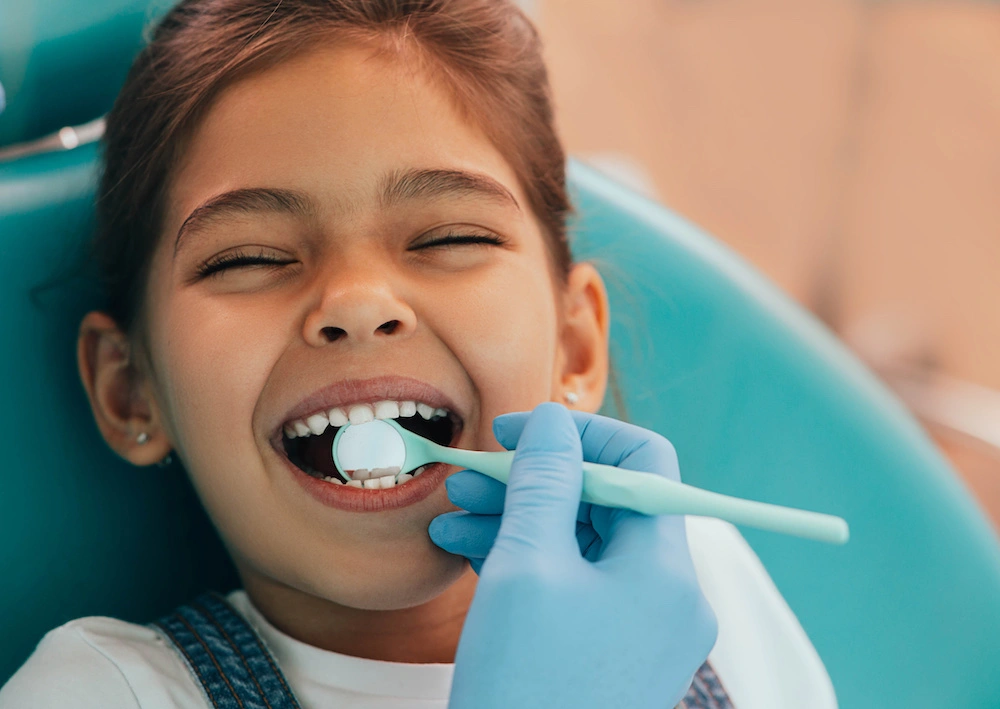
Not every lost baby tooth calls for an appliance. Front teeth that come out a little early often leave enough room on their own, and a molar lost close to its natural time may not need anything at all. The cases we watch most closely are back teeth lost years ahead of schedule, because those teeth hold space for the premolars and help guide the six-year molars into place.
Talk with us about a space maintainer if your child:
If you are not sure whether a gap needs attention, bring your child in. A quick exam and x-ray usually answer the question in one visit.
Dr. Wang chooses the design based on which tooth is missing, your child’s age, and how many teeth are involved. Most children only ever need one of these.
The most common option for a single missing molar. A stainless steel band fits around the tooth next to the gap, and a small wire loop reaches across to rest against the tooth on the other side.
Works the same way as a band and loop, but the wire is attached to a stainless steel crown. It is a good fit when the anchor tooth also needs a pediatric dental crown.
A wire that runs along the inside of the lower teeth, anchored to the molars on both sides. It protects space when back teeth are missing on both sides of the jaw.
Used when a second baby molar is lost before the six-year molar behind it has come in. A small extension sits just under the gum to guide that permanent molar into the right spot.
An acrylic piece, similar to a retainer, that your child can take out for cleaning. It can replace more than one tooth and usually works best for older children who will wear it consistently.
Dr. Wang checks the gap, your child’s bite, and an x-ray of the developing adult tooth. If that tooth is already close to coming in, a maintainer may not be needed at all, and we will tell you so.

A band and loop is the most common choice for one missing molar. A lingual arch protects several spaces in the lower jaw, a distal shoe guides an unerupted six-year molar, and a removable option suits some older children.

We take a quick impression of the area so the appliance is built for your child’s mouth. Sizing the band takes only a few minutes and usually does not require numbing.

A fixed maintainer is cemented to the anchor tooth in one short appointment. Your child may notice it with their tongue for a few days, and most kids stop thinking about it soon after.

We check the appliance at every six-month visit. Once the permanent tooth starts to break through, we remove the maintainer in a quick, comfortable visit.
Teeth naturally drift toward open space. When a baby molar comes out early, the molar behind it can tip forward and the teeth in front can lean back, and that shifting can start within the first few months. By the time the permanent tooth is ready, the gap may be too small for it.
The result can be crowding, a permanent tooth that comes in at an angle or stays stuck under the gum, and bite problems that take more work to correct later. Holding the space with a small, temporary appliance is usually far simpler than moving teeth back into position down the road.
That is why we like to plan a space maintainer soon after a tooth is lost. When we remove a baby tooth at our office, we often map out the appliance at the same visit. If an injury knocks out or breaks a back tooth, call us and our pediatric emergency dentistry team will see your child as soon as possible and talk through whether the space needs protecting.
Fixed space maintainers need very little special care, but a few habits help them last until they are no longer needed.
If the appliance comes loose, bends, or rubs the gums, call us at (510) 980-7325. Fixing it early keeps the space protected.
Dr. Michael Wang grew up in the Bay Area, earned his dental degree at the UCSF School of Dentistry, and completed his pediatric residency at Montefiore Medical Center in the Bronx. He has been a board-certified pediatric dentist since 2019, so watching how baby teeth come out and adult teeth come in is a core part of his everyday work with kids.
Our office on Mission Boulevard serves families across Fremont, from Mission San Jose and Irvington to Niles, Centerville, and Warm Springs. Dr. Wang speaks fluent Mandarin and Spanish, which helps many families talk through treatment comfortably, and children who feel nervous about dental work can ask us about sedation dentistry options.
Questions about cost? Review our insurance information and financing options, or call our team and we will walk you through it.
It depends on which tooth was lost and how far along the permanent tooth is. Some children wear a maintainer for several months, others for a few years. Your child’s x-rays show roughly when to expect the adult tooth, and we will share that timeline with you at the first visit. We remove the appliance once the permanent tooth starts to come in.
Most kids find the process easy. Fitting the band feels like a little pressure on the tooth, and placing a fixed maintainer usually does not require any numbing. It is common for the area to feel a bit strange for the first few days while your child gets used to it with their tongue. If anything rubs or feels sore after that, let us know and we can adjust it.
No. Front teeth lost a little early often leave enough room on their own, and a molar that comes out close to its natural time may not need anything at all. Dr. Wang looks at which tooth was lost, your child’s age, and how close the permanent tooth is to erupting before recommending an appliance. If one is not needed, we will tell you and simply keep an eye on the area at regular cleanings and exams.
Save the appliance if it comes out and call our office at (510) 980-7325. A loose or bent maintainer is usually not a dental emergency, but we want to see your child soon so we can recement or replace it before the space starts to close. If the wire is poking the cheek or gums, a small piece of orthodontic wax or sugar-free gum can cover it until the visit.
Yes. Most children eat their usual meals without any trouble. The main things to avoid are sticky or very hard foods like caramel, taffy, gum, hard candy, and ice, since they can bend the wire or pull the band loose. Cutting tougher foods into smaller pieces also helps.
Many dental plans include space maintainers as part of their children’s benefits, but coverage varies from plan to plan. Our team is happy to check your benefits before treatment. You can also review our insurance information and financing options, or contact us with questions.
We use cookies to improve your experience on our site. By using our site, you consent to cookies.
Manage your cookie preferences below:
Essential cookies enable basic functions and are necessary for the proper function of the website.
CloudFlare provides web performance and security solutions, enhancing site speed and protecting against threats.
Service URL: developers.cloudflare.com (opens in a new window)
These cookies are needed for adding comments on this website.
Google reCAPTCHA helps protect websites from spam and abuse by verifying user interactions through challenges.
Google Tag Manager simplifies the management of marketing tags on your website without code changes.
Statistics cookies collect information anonymously. This information helps us understand how visitors use our website.
Google Analytics is a powerful tool that tracks and analyzes website traffic for informed marketing decisions.
Service URL: policies.google.com (opens in a new window)
Marketing cookies are used to follow visitors to websites. The intention is to show ads that are relevant and engaging to the individual user.
Google Maps is a web mapping service providing satellite imagery, real-time navigation, and location-based information.
Service URL: policies.google.com (opens in a new window)