
When a baby tooth’s nerve becomes infected or badly decayed, pulp therapy — often called a “baby root canal” — treats the infected pulp so the tooth can stay in place and keep doing its job until it’s naturally ready to come out. Dr. Michael Wang and the Mission Peak Pediatric Dentistry team perform this treatment, clinically known as a pulpotomy, to remove the affected pulp tissue and protect what remains with a crown.
Pulp therapy is similar to an adult root canal, but scaled to a child’s smaller, still-developing tooth. Instead of removing all of the pulp, a pulpotomy removes only the infected portion and leaves healthy tissue in place, so the tooth can keep supporting your child’s bite and guiding the permanent tooth in underneath. Milpitas families make the short trip up I-680 or I-880 to reach our Fremont office for this treatment.
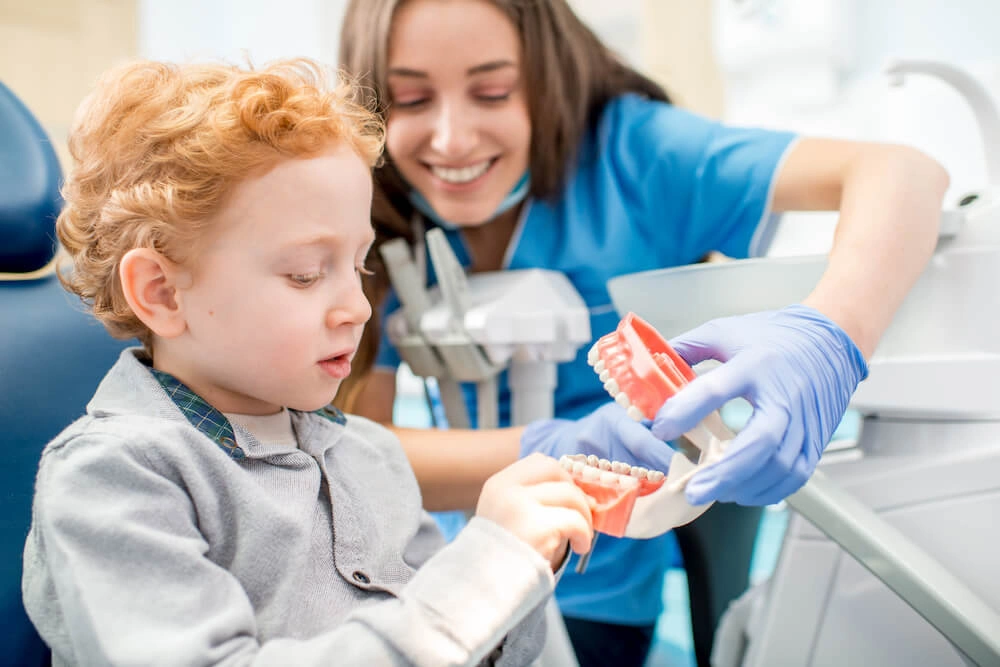

Before treatment begins, Dr. Wang numbs the area around your child’s tooth, and sedation is available for kids who feel anxious about dental visits. Once your child is comfortable, any decayed enamel on the outside of the tooth is gently removed.

Next, Dr. Wang creates a small opening in the tooth to reach the infected pulp and removes it. A medicated dressing is placed inside the tooth to calm the area and help prevent the infection from returning, and the opening is sealed.

To finish, a stainless steel crown is placed over the treated tooth. The crown protects the remaining structure and keeps the tooth strong until it’s naturally ready to fall out, holding space for the permanent tooth growing in underneath.
An infected baby tooth can cause real pain and disrupt sleep, meals, and school days. Pulp therapy relieves that pain so your child — and the rest of the household — can get back to a normal routine.
Left untreated, an infected tooth typically gets worse and often ends in extraction. Losing a baby tooth too early can let neighboring teeth drift into the gap, crowding out space the permanent tooth will need. Pulp therapy is usually the more conservative option, keeping the natural tooth in place until it’s ready to come out on its own.
Treating an infected tooth early with pulp therapy is generally more straightforward than the extraction and space-maintainer route that’s often needed once a tooth has to be pulled. For families driving in from Milpitas, catching the problem early can also mean fewer follow-up visits.
An infected baby tooth can cause real pain and disrupt sleep, meals, and school days. Pulp therapy relieves that pain so your child — and the rest of the household — can get back to a normal routine.
Left untreated, an infected tooth typically gets worse and often ends in extraction. Losing a baby tooth too early can let neighboring teeth drift into the gap, crowding out space the permanent tooth will need. Pulp therapy is usually the more conservative option, keeping the natural tooth in place until it’s ready to come out on its own.
Treating an infected tooth early with pulp therapy is generally more straightforward than the extraction and space-maintainer route that’s often needed once a tooth has to be pulled. For families driving in from Milpitas, catching the problem early can also mean fewer follow-up visits.
No. We fully numb the treatment area before starting, and sedation options are available for children who feel nervous about the visit. Most kids feel little to nothing during the procedure, and any soreness afterward is typically comparable to a routine filling.
Most pediatric dental plans cover pulp therapy since it’s considered medically necessary treatment for an infected tooth. Coverage amounts vary by plan, so we recommend checking with your insurer or bringing your policy details to your visit so our team can help you understand your benefits.
We use cookies to improve your experience on our site. By using our site, you consent to cookies.
Manage your cookie preferences below:
Essential cookies enable basic functions and are necessary for the proper function of the website.
CloudFlare provides web performance and security solutions, enhancing site speed and protecting against threats.
Service URL: developers.cloudflare.com (opens in a new window)
These cookies are needed for adding comments on this website.
Google reCAPTCHA helps protect websites from spam and abuse by verifying user interactions through challenges.
Google Tag Manager simplifies the management of marketing tags on your website without code changes.
Statistics cookies collect information anonymously. This information helps us understand how visitors use our website.
Google Analytics is a powerful tool that tracks and analyzes website traffic for informed marketing decisions.
Service URL: policies.google.com (opens in a new window)
Marketing cookies are used to follow visitors to websites. The intention is to show ads that are relevant and engaging to the individual user.
Google Maps is a web mapping service providing satellite imagery, real-time navigation, and location-based information.
Service URL: policies.google.com (opens in a new window)