
When a dentist tells a Newark parent that their child needs a baby root canal, the first thing that usually comes to mind is the long, uncomfortable procedure adults associate with root canals of their own. That worry is completely normal, yet it rarely matches what pulp therapy for a small, growing tooth actually looks like in a pediatric setting.
Mission Peak Pediatric Dentistry treats pulp therapy as a calm, routine part of caring for a child’s smile, not something to dread or delay. Our team regularly performs pulpotomies to ease discomfort, save a tooth that still has healthy roots, and protect the smile your child can carry into their permanent teeth for years to come. We build our approach around clear explanations, a gentle pace, and plenty of reassurance for both you and your child before any treatment begins.
According to the American Academy of Pediatric Dentistry’s clinical guideline on vital pulp therapy, treating the soft tissue inside a primary tooth can help preserve the tooth’s function until it naturally falls out on its own timeline. Pulp therapy typically involves removing the affected portion of the tooth’s inner tissue, cleaning the remaining space thoroughly, and sealing it with a protective material, often topped by a crown or filling to restore normal chewing and biting.
Baby teeth do more than fill space in a growing mouth. They help your child chew comfortably, speak clearly, and guide the permanent teeth into their proper position later on, which is why we often try to treat and save a tooth rather than moving straight to removal. Our post on pulpotomies versus baby root canals walks through the terms in more detail, including how each approach differs and what typically happens at each stage of treatment.
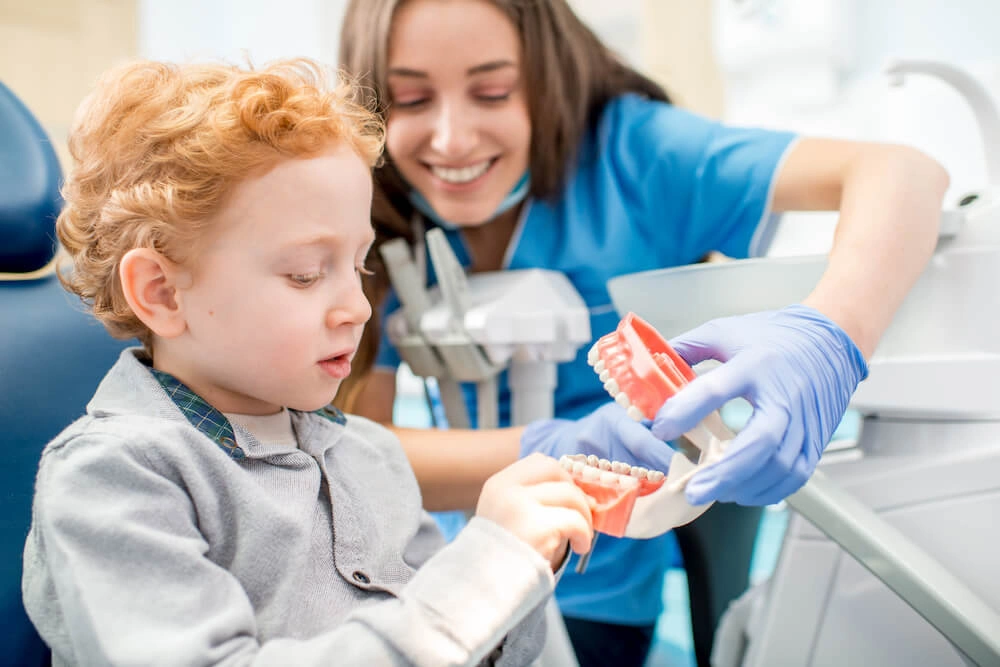
Baby teeth do more work than most parents realize, and losing one too early can affect chewing, speech development, and the position of the permanent tooth waiting underneath. Pulp therapy gives us a way to treat the infection while preserving that natural spacer, which often means fewer complications for the permanent tooth developing beneath it.
Untreated decay is more common than many parents expect, and it rarely resolves on its own. According to the CDC’s 2024 Oral Health Surveillance Report, nearly 18 percent of children between ages 6 and 8 had at least one primary tooth with untreated decay, a rate that climbs even higher in underserved communities. Catching decay before it reaches the pulp is always preferable, but when it does progress that far, pulp therapy offers a reliable way to intervene without pulling the tooth.

Every child is different, but a few common signs can point to a tooth that may benefit from pulp therapy rather than a simple filling. If you notice any of the following near a specific tooth, it is worth having a dentist take a closer look before the issue grows more uncomfortable for your child.
None of these signs mean your child is facing anything serious, and catching them early often makes treatment simpler, faster, and more comfortable for everyone involved. When a tooth can be saved, we typically recommend pulp therapy over extraction because primary teeth act as natural placeholders that guide the permanent teeth growing underneath them. Our post comparing pulpotomy and extraction breaks down how we weigh each option for different situations, and families near NewPark Mall and Ohlone College’s Newark Center for Health Sciences often ask us this exact question at their child’s next visit.
Pulp therapy works well for many cases, but occasionally decay or damage is too extensive for the tooth to be saved even with treatment. When that happens, we talk through options like tooth extractions and explain what comes next for your child’s bite and future permanent teeth. Every recommendation we make is based on what gives your child the healthiest long-term outcome, not simply the fastest fix.
Dr. Michael Wang leads care at Mission Peak Pediatric Dentistry, and his background gives Newark and Fremont families real confidence when a child needs pulp therapy. Born and raised in the Bay Area, he earned a degree in human biology and a master’s degree in biological sciences from UC San Diego before completing his DDS at the UCSF School of Dentistry, one of the most respected dental schools in the country.
He completed his pediatric residency at Montefiore Medical Center’s Einstein Campus in the Bronx, and the American Academy of Pediatric Dentistry board certified him in 2019, a credential that reflects years of focused pediatric training beyond dental school. Dr. Wang also speaks fluent Mandarin and Spanish, which helps many Newark-area households feel comfortable discussing treatment options in the language they know best. You can read more about Dr. Wang and our team on our About page, and Newark-area families can find visit details on our Newark location page.
Choosing a dental home for your child’s pulp therapy comes down to trust, comfort, and a team that treats every visit as a chance to build good habits for later years. Dr. Wang’s training, from the UCSF School of Dentistry to his board certification in pediatric dentistry, gives Newark and Fremont families a steady hand for procedures that might otherwise feel intimidating for a young child. Our whole team works to keep appointments calm, clear, and paced to what your child can handle that day.
Our goal is simple: help your child leave every appointment feeling calmer about the dentist than when they walked in, whether that visit involves a routine cleaning or pulp therapy for a tooth that needs extra support. If your child has tooth pain, swelling, or sensitivity, or if you simply want a second opinion from a caring team near Newark, schedule a visit with Mission Peak Pediatric Dentistry today.
We use cookies to improve your experience on our site. By using our site, you consent to cookies.
Manage your cookie preferences below:
Essential cookies enable basic functions and are necessary for the proper function of the website.
CloudFlare provides web performance and security solutions, enhancing site speed and protecting against threats.
Service URL: developers.cloudflare.com (opens in a new window)
These cookies are needed for adding comments on this website.
Google reCAPTCHA helps protect websites from spam and abuse by verifying user interactions through challenges.
Google Tag Manager simplifies the management of marketing tags on your website without code changes.
Statistics cookies collect information anonymously. This information helps us understand how visitors use our website.
Google Analytics is a powerful tool that tracks and analyzes website traffic for informed marketing decisions.
Service URL: policies.google.com (opens in a new window)
Marketing cookies are used to follow visitors to websites. The intention is to show ads that are relevant and engaging to the individual user.
Google Maps is a web mapping service providing satellite imagery, real-time navigation, and location-based information.
Service URL: policies.google.com (opens in a new window)